By RWT Robotics Editorial Team Published
DEMO ONLY
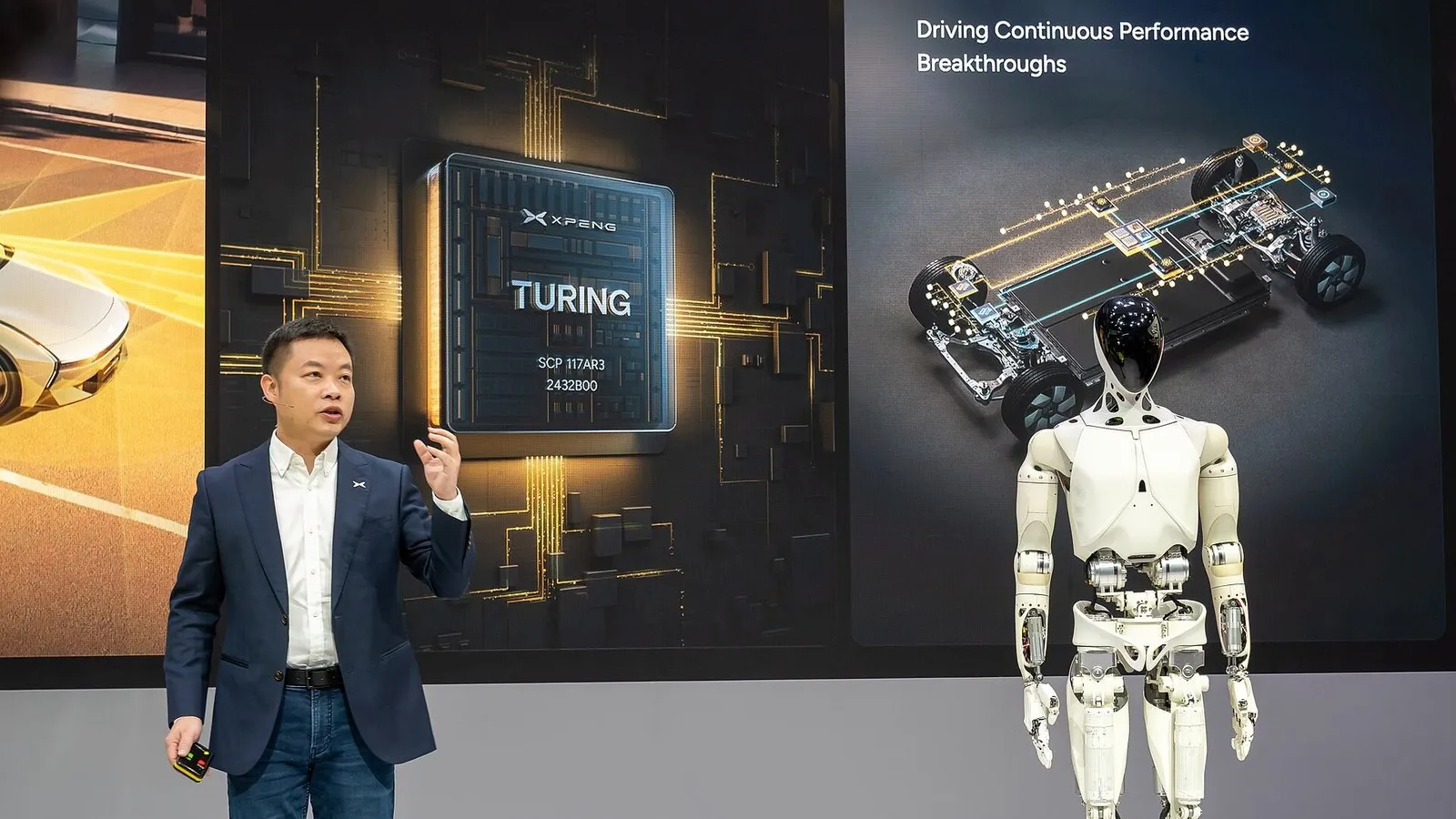
XPeng’s newsroom says the production version of its IRON humanoid has 76 degrees of freedom, 21 of them in each hand, and that market launch and deliveries in China and overseas are planned for 2027. Most of what makes IRON sound close to ready, from its tactile sensing to its eventual role in homes, still rests on company statements made around a launch event. No outside party has published a measurement of what the robot can actually do, and the price is still a comparison, not a number.
What we know
The hard numbers come from XPeng itself. Its official newsroom and product page list 76 degrees of freedom across the production IRON, with 21 per hand. That is a step down from the prototype XPeng debuted in November 2025, which had synthetic skin and 82 degrees of freedom, including 22 per hand.
Fewer joints in a production design is not automatically a downgrade. Every actuator adds cost, mass, heat and another thing that can fail, and trimming joints is a normal move when a lab prototype becomes something a factory has to build repeatedly. Without knowing which joints were removed, though, nobody outside XPeng can say what the change costs in dexterity.
The manufacturing timeline has moved in visible steps. In July 2026, IRON entered small-batch trial production at XPeng’s Guangzhou factory. In September 2026, the production line started. XPeng’s stated goal is mass production by the end of 2026, which is now about a month away.
On homes and price, XPeng co-president Brian Gu told CNBC that home deployment could follow successful commercial use by one to two years. He also said IRON could be priced near the median selling price of an electric vehicle, without giving an exact figure. Coverage of the interview notes there is no firm timetable for a household launch. We are working from secondary outlets that relayed the CNBC interview; we have not reviewed the CNBC article directly.
One older claim no longer holds. A BGR report said XPeng was not targeting chores or factory jobs for its humanoid. XPeng’s later 2026 statements say commercial use comes first and homes follow, and Live Science reports XPeng representatives saying the robots could one day help with cleaning and laundry. The chores part of that report is contradicted by the company’s own framing.
What is rumored
eWeek, relaying a report sourced to The Wall Street Journal, says IRON would work as a sales assistant in XPeng showrooms in China in the first quarter of 2027, then in overseas stores later that year. The same report says XPeng aims to produce more than 1,000 units per month by the end of 2026.
We grade this B, with caveats. eWeek is secondhand here, and we have not checked the claims against the original WSJ article. The showroom timing matches XPeng’s own statements about showroom roles in 2027, which makes that half plausible. The capacity figure has no confirmation from XPeng or anyone else, and it should be treated as a reported target, not a production fact.
What we don’t know yet
The biggest open question is how the AI Day stage demo was controlled. No source we have says whether it was autonomous, scripted or teleoperated. That distinction matters more than any spec sheet. A teleoperated humanoid proves the hardware can move; an autonomous one proves the software can decide. XPeng did describe the robot’s walk-off from the production line as autonomous, but that is the company’s description, not an independent observation.
XPeng’s launch messaging also cited more than 1,500 tactile sensors. Sensor count tells you how much data the hands can collect. It does not tell you whether the control stack can use that data to grip a wet glass or fold a shirt, and we have seen no test of either.
Then there is price. “Near the median selling price of an EV” is a useful signal of ambition, but EV prices vary widely by market, and Gu gave no figure. Until XPeng publishes a number, any dollar estimate you see is someone’s guess.
The launch narrative also mentioned a target of tens of thousands of units in sales. The sources available to us give no timeframe, market split or buyer breakdown for that figure, so we cannot assess it.
Finally, mass-production cost and efficiency are untested. Building a few robots on a new line is a different engineering problem from building many reliably and cheaply. The material we have says nothing about runtime, payload, uptime or failure rates.
What it means
Stated specs describe capability, not demonstrated real-world performance. Seventy-six degrees of freedom is a design parameter. What buyers will care about is how often IRON finishes a task without help, and how much that costs per hour.
The showroom-first plan is the sensible part of this story. A dealership floor is a controlled, well-lit, mostly predictable space, the tasks are forgiving, and a robot greeting customers doubles as advertising for XPeng’s own engineering. If something goes wrong, staff are right there. That is a reasonable place to collect deployment data.
Homes are a much harder environment: clutter, pets, stairs, children, soft and deformable objects, and no technician on site. Gu’s one-to-two-year gap after commercial use is a conditional estimate, not a schedule, and coverage of his comments confirms there is no firm household timetable.
Here is what would move IRON from demo to evidence for us: footage with the control mode disclosed, published task success rates from real showroom shifts, an actual price, and confirmation from XPeng of its monthly output. Until then, IRON is a well-specified robot with a credible production line and a plausible first job. Whether it can do that job, and at what cost, nobody outside XPeng has shown yet.
Follow every development in one place on our humanoid robot tracker.
Keep reading
 Robotics NewsGerman filing shows Tesla seeking EMAG assets, Optimus link unconfirmedTesla told Germany's cartel office it plans to buy EMAG assets. No price is given, and the Optimus…Nov 27, 2026 · 5 min read
 Robotics NewsTesla’s first limited AI5 chips reportedly go to Optimus and data centersReports say Tesla's first AI5 chips go to Optimus and data centers. Musk backs that priority, but the…Nov 27, 2026 · 5 min read
 Robotics NewsCiti initiates Agility Robotics at Buy after shares fall about 52% since debutCiti started Agility Robotics at Buy, per CNBC, after a roughly 52% slide since its Nov 5 IPO.…Nov 25, 2026 · 4 min read
Credits and sources
By RWT Robotics Editorial Team
- Published