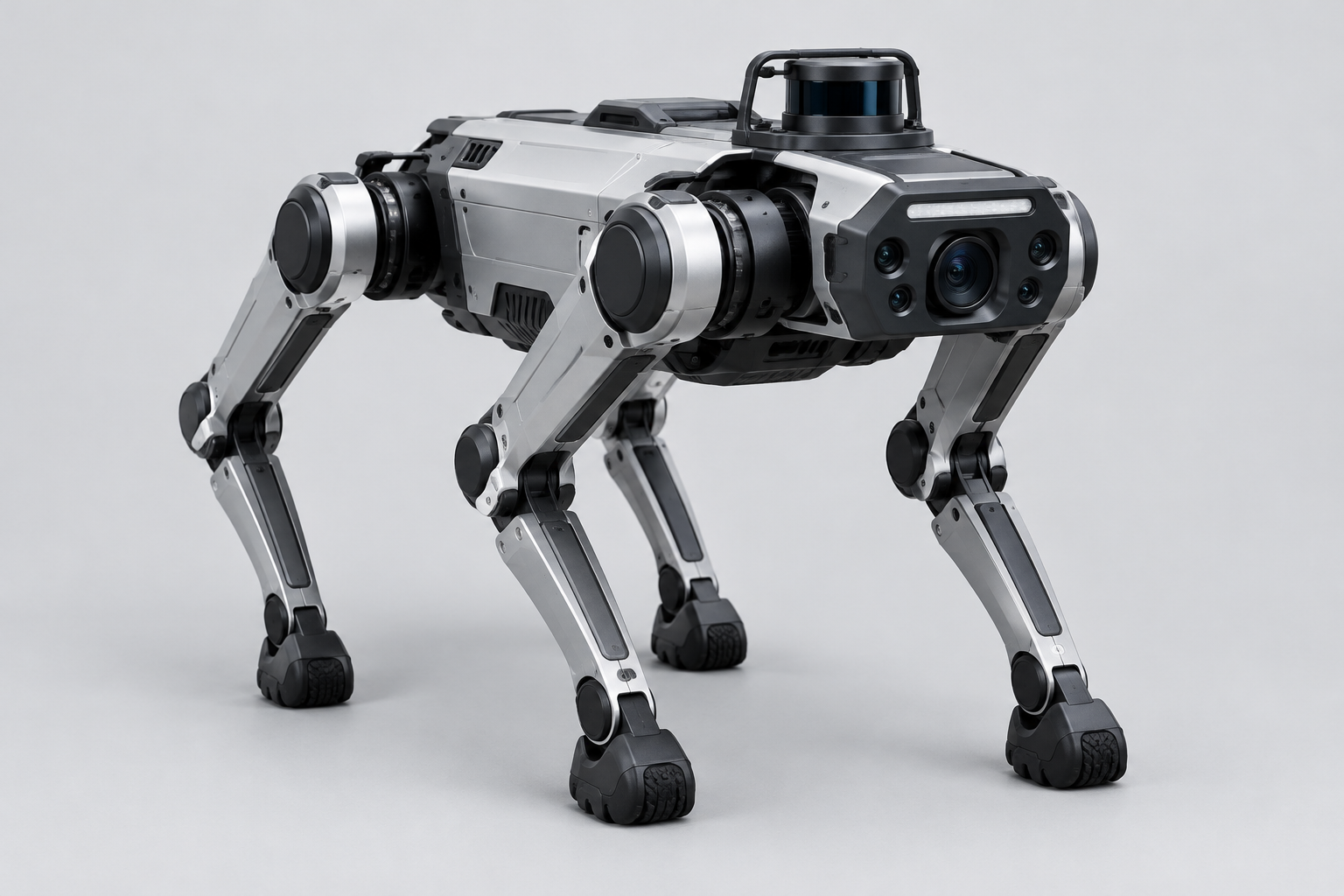
A dog robot is a four-legged machine that walks, balances and senses its surroundings using electric motors, cameras and onboard software. Modern models range from palm-sized programmable kits at a few hundred dollars to industrial quadrupeds that inspect power plants for tens of thousands. This guide covers what each class can do today, what is still demo footage, and how to choose.
What a dog robot actually is
Engineers call these machines quadrupeds. “Robot dog” is the popular name, and it stuck because of the shape: four legs, a body and a head-like sensor cluster at the front.
The category is broad. It covers three different kinds of product:
- Companion robots built for emotional interaction, such as Sony’s aibo.
- Consumer and research quadrupeds such as the Unitree Go2 or Xiaomi CyberDog, which you can program.
- Industrial quadrupeds such as Boston Dynamics Spot or ANYbotics ANYmal, which carry sensors through factories, substations and offshore platforms.
The terms people search for, like “android dog”, “dog droid” or “droid dog”, almost always point to the same machines. Science fiction coined those terms. No manufacturer uses “android” for a quadruped, because android technically means a robot shaped like a human.
How modern robot dogs work
Motors, joints and legs
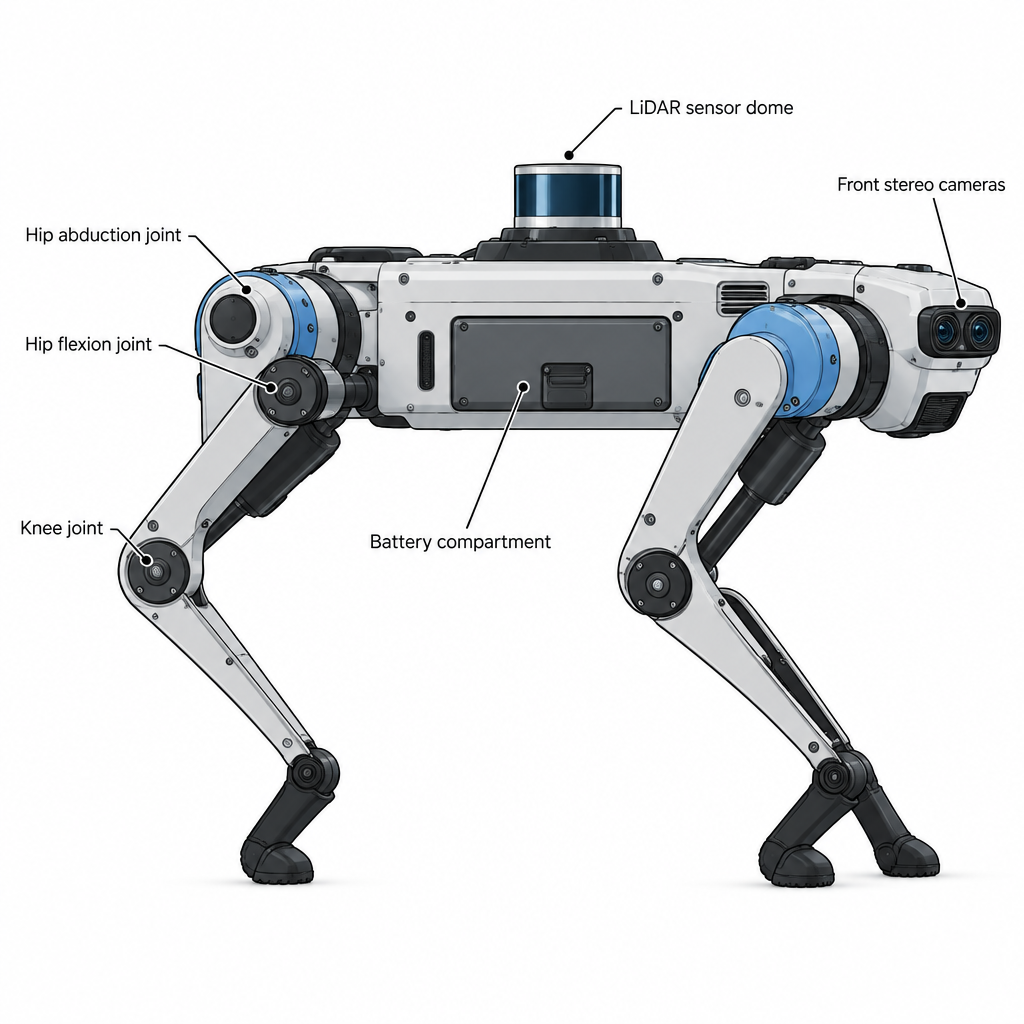
Most current quadrupeds have 12 actuated joints, three per leg: hip abduction, hip flexion and knee. Spot and the Unitree Go2 both follow this layout.
The big shift of the last decade was the move to electric motors with low gear ratios, often called proprioceptive or quasi-direct-drive actuators. MIT’s Mini Cheetah popularized the approach, and it famously did a backflip in 2019. These motors are cheap, back-drivable and responsive enough to feel ground contact through current readings alone.
Older large robots used hydraulics. Boston Dynamics’ BigDog, funded by DARPA and unveiled in 2005, ran on a gasoline engine driving hydraulic actuators. It worked, but it was loud. Its successor, the LS3, could carry heavy loads for soldiers. The US Marine Corps shelved it in 2015, largely because of the noise.
Today almost every commercial dog robot is battery-electric.
Robot dog camera, depth and LiDAR
Perception decides whether a quadruped can climb stairs without tripping. Here is how the main platforms see:
- Spot uses five pairs of stereo cameras around its body (front, both sides and rear) for obstacle avoidance and terrain mapping.
- Unitree Go2 carries Unitree’s own L1 LiDAR, which the company describes as a “4D” sensor with a hemispherical 360° by 90° field of view. It also has a wide-angle HD camera in the front.
- Sony aibo (ERS-1000) has a camera in its nose for recognizing faces and objects, plus a separate SLAM camera on its back that it uses to map your home.
Payload cameras are a separate topic. For inspection work, Boston Dynamics sells Spot CAM+ with a pan-tilt-zoom camera offering 30x optical zoom. Spot CAM+IR adds a thermal imager for spotting hot electrical components.
If you see “robot dog camera” in a product listing, check which camera does what. The navigation cameras on a consumer model are often low resolution and tuned for depth. They are not designed for good video of your living room.
Robot dog artificial intelligence: what the AI really does
“AI powered robot dog” shows up in a lot of marketing copy. In practice, AI does three separate jobs on a modern quadruped.
1. Locomotion. This is where machine learning has made the biggest real difference. Researchers train walking policies with reinforcement learning in a physics simulator, running thousands of virtual robots in parallel, then transfer the result to the real machine. ETH Zurich’s ANYmal team published landmark work on this in Science Robotics in 2019 and 2020. Later work showed ANYmal hiking a Swiss mountain trail using learned perceptive locomotion. Boston Dynamics has said it now uses reinforcement learning alongside its model-based controllers on Spot.
2. Perception and navigation. Object detection, person following, mapping and path planning. Much of this is classic robotics (SLAM, costmaps, planners) with neural networks handling recognition.
3. Interaction. This is the newest layer. Unitree markets the Go2 Pro with voice interaction and large-language-model integration. In October 2023 Boston Dynamics showed Spot acting as a talking tour guide driven by ChatGPT, and presented it as a proof of concept, not a product feature.
Reality check
An LLM that chats with you is not the same as an autonomous robot dog that decides where to go. Voice features on consumer quadrupeds mostly trigger preset actions.
The dog robot models worth knowing
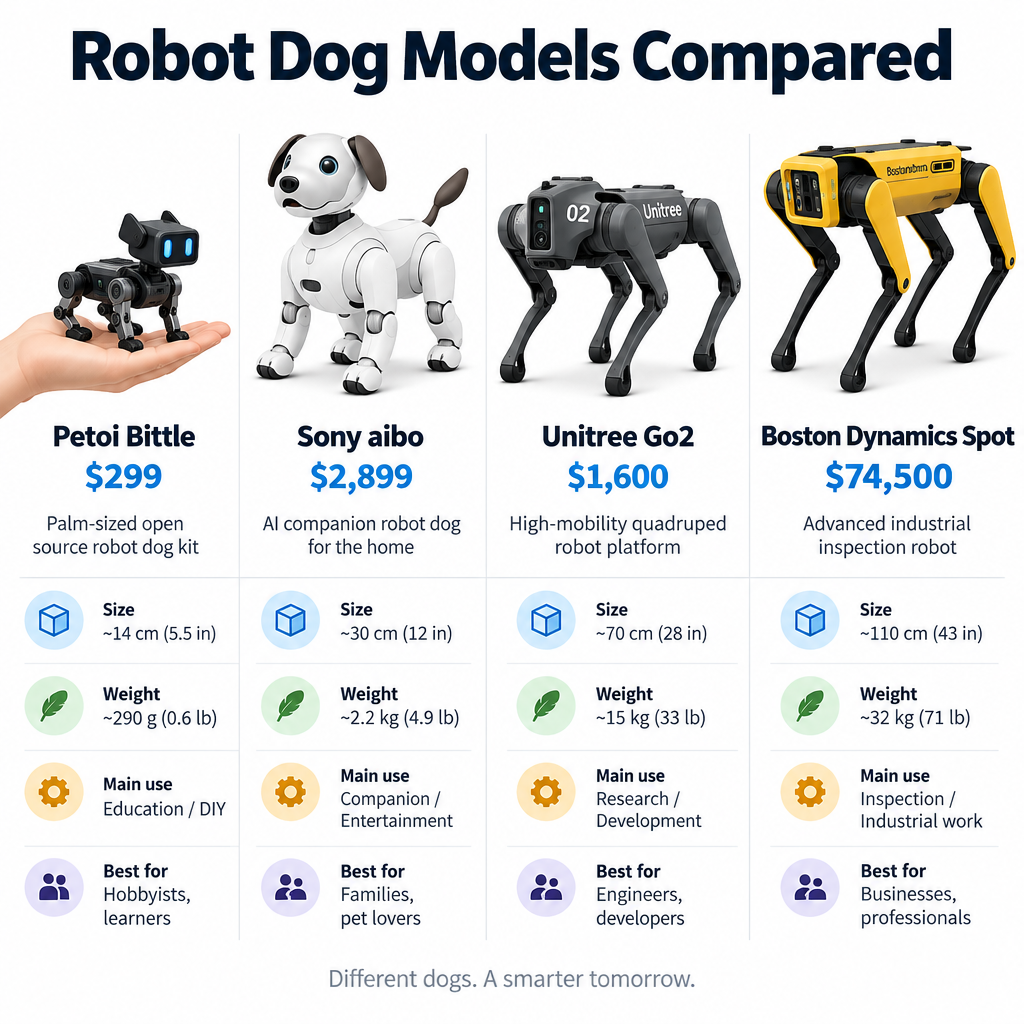
Here is the shortlist, grouped by what you would actually use them for. Prices are list or launch prices where the maker published them. Several industrial makers only quote on request.
| Model | Maker | Class | Weight | Price |
|---|---|---|---|---|
| Petoi Bittle | Petoi | Programmable kit | Palm-sized | Roughly $300 |
| aibo ERS-1000 | Sony | Companion | 2.2 kg | $2,899 at US launch |
| CyberDog 2 | Xiaomi | Consumer / dev | About 8.9 kg | About CNY 13,000 at launch |
| Go2 Air / Pro | Unitree | Consumer | About 15 kg | $1,600 / $2,800 |
| Go2 EDU | Unitree | Research | About 15 kg | Quote |
| Spot | Boston Dynamics | Industrial | About 32.7 kg | $74,500 base (2020) |
| B2 | Unitree | Industrial | About 60 kg | Not publicly listed |
| ANYmal | ANYbotics | Industrial | About 50 kg class | Quote |
Unitree Go2
Unitree, based in Hangzhou, launched the Go2 in July 2023 as a successor to the Go1. It is the default answer for anyone who wants a capable dog robot without a five-figure budget.
| Spec | Go2 Air | Go2 Pro | Go2 EDU |
|---|---|---|---|
| Price | $1,600 | $2,800 | Quote |
| Max speed (Unitree figure) | About 2.5 m/s | About 3.5 m/s | About 3.7 m/s |
| Joints | 12 | 12 | 12 |
| LiDAR | L1 4D | L1 4D | L1 4D |
| Voice / LLM features | No | Yes | Yes |
| Secondary development | Limited | Limited | Full SDK |
| Onboard AI compute | No | No | Jetson Orin module |
Unitree quotes a weight of roughly 15 kg with the battery and runtime of about 1 to 2 hours on the standard pack. A larger optional battery extends that. Standing, the Go2 is about 70 cm long and 40 cm tall.
What it can really do (shipped): walk, trot and climb moderate stairs and slopes, follow you, avoid obstacles using LiDAR, and perform built-in tricks such as handstands and flips from the app. The Pro adds voice commands.
What is demo territory: much of Unitree’s promotional video features choreographed sequences and acrobatics. Unitree does not always say which clips are remote-controlled. Assume the flashy parkour runs are operator-triggered moves from a library, not the robot deciding to do them.
Engineer's note
If you want to write your own control code or run ROS 2 on the robot, buy the EDU. The Air and Pro restrict low-level access, and many buyers only discover this after unboxing.
Boston Dynamics Spot
Spot is the reference industrial dog robot. Boston Dynamics, owned by Hyundai since 2021, opened general sales in June 2020 at $74,500 for the base robot. Configurations with the arm, payload cameras and enterprise software cost considerably more, and current pricing is by quote.
| Spot spec | Value |
|---|---|
| Weight | About 32.7 kg |
| Payload | 14 kg |
| Max speed | 1.6 m/s |
| Runtime | About 90 minutes |
| Ingress protection | IP54 |
| Perception | 5 stereo camera pairs |
Shipped capability: Autowalk lets you record an inspection route once, then have Spot repeat it autonomously, capturing gauge readings, thermal images or acoustic data at set points. The Spot Arm can open doors and manipulate valves. Spot Enterprise works with a dock that lets the robot charge itself and offload data without a human present.
That combination makes Spot one of the few genuinely autonomous robot dog products in daily commercial use. The autonomy is narrow: repeat a known mission, handle obstacles along the way, return to charge. It is not wandering a site and deciding what to inspect.
Spot is slower than the Go2. That is a design choice. Industrial buyers care about repeatability, stair reliability and uptime, not top speed.
Large and giant robot dogs
Searches for “large robot dog” and “giant dog robot” usually lead to these machines.
- Unitree B2. Unitree’s industrial quadruped, announced in 2023. Unitree lists it at about 60 kg with a walking payload around 40 kg and a top speed over 6 m/s. A wheeled variant, the B2-W, swaps feet for driven wheels. Pricing is not published.
- ANYbotics ANYmal. The Swiss ETH Zurich spin-off builds ANYmal for energy and process industries. ANYmal X is certified for use in potentially explosive atmospheres, which matters on oil and gas sites where most robots are banned.
- Ghost Robotics Vision 60. A rugged quadruped sold mainly to defense and security customers. South Korea’s LIG Nex1 acquired a majority stake in Ghost Robotics in 2024.
- Deep Robotics X30. From Hangzhou-based Deep Robotics, aimed at substation and tunnel inspection. The company rates it for weather sealing and cold-weather operation; independent long-term field data is limited.
Historically, the true giants were hydraulic. BigDog and LS3 remain the largest legged robot dogs most people have seen, and neither was sold commercially.
Companion robots: Sony aibo and the “corgi robot” question
Sony’s aibo has the longest history in the field. Sony announced the first model, the ERS-110, in May 1999 and began taking orders in Japan on June 1, 1999, at 250,000 yen. Sony discontinued the line in 2006, then relaunched aibo as the ERS-1000 in January 2018.
The current aibo weighs 2.2 kg and has 22 degrees of freedom, far more than an industrial quadruped. Most of those extra axes go to the head, ears, mouth and tail, because aibo’s job is expression. OLED eyes, touch sensors and cloud-based learning let it recognize family members and develop habits over time. In the US it launched in September 2018 at $2,899, with the AI Cloud Plan sold as a separate, required subscription. In Japan the price is 198,000 yen plus a paid subscription.
You cannot program aibo the way you program a Go2, although Sony has offered some developer and visual programming tools.
Corgi robot: We could not find a shipping commercial legged robot designed as a corgi. Results for that search are mostly toys, plush robots and hobbyist builds. If you want a small-breed-sized companion, aibo is the closest serious product.
For older adults, Tombot’s Jennie takes a different route: a realistic Labrador puppy designed with Jim Henson’s Creature Shop. It responds to touch and voice but does not walk. Check Tombot directly for current availability, since it has been sold through preorders.
Programmable kits: Petoi Bittle and Xiaomi CyberDog
A programmable robot dog at hobby prices is the best way to learn legged robotics without risking a $3,000 machine.
Petoi Bittle is a palm-sized open-source quadruped that launched on Kickstarter in 2020. It runs on an Arduino-compatible board, and you can program it in block code, C++ or Python. It uses small servos, not torque-controlled motors, so its gaits are far simpler than a Go2’s. Kits sell for roughly $300 depending on version.
Xiaomi CyberDog arrived in August 2021 at CNY 9,999, as a limited run aimed at engineers. It used an NVIDIA Jetson Xavier NX and an open-source software stack built on ROS 2. CyberDog 2 followed in August 2023 at about CNY 13,000, with a smaller, Doberman-like body. Availability outside China has always been limited.
Shipped vs demo: how to read robot dog videos
Most of what you see online is real hardware. The question is who is in control.
Here is the checklist we apply to any launch video:
- Is there an operator? Look for a person holding a tablet or controller at the edge of the frame. Many “autonomous” clips are teleoperated.
- Is it sped up? Watch leg cadence. A 15 kg robot trotting suspiciously fast is often 2x footage.
- Is the terrain prepared? Obstacle courses built for the shoot are not the same as a messy building site.
- Did the company say how many takes it took? They rarely do. Assume more than one.
- Is it a tethered lab result? In 2012, Boston Dynamics’ Cheetah hit 28.3 mph on a treadmill. It was tethered and powered externally. Nothing in that clip was a product.
Boston Dynamics and ETH Zurich publish technical detail for most of their headline demos. Consumer brands often publish only the edited video.
Reality check
Fully autonomous robot dogs that operate unsupervised in homes or public spaces for days at a time do not exist as products. Industrial autonomy is real but limited to pre-mapped routes.
Programmable robot dogs: what you can build
Once you have SDK access, a quadruped becomes a mobile sensor platform. Common projects include:
- Autonomous patrol routes using Nav2 on top of the robot’s odometry and LiDAR
- Person following with a depth camera and a detection model on the onboard Jetson
- Training your own locomotion policies in simulation and deploying them (advanced, and risky on hardware)
- Data collection for mapping, inspection or research datasets
The main software routes:
| Platform | Official SDK | ROS 2 path |
|---|---|---|
| Unitree Go2 EDU | unitree_sdk2 (C++, DDS based) | unitree_ros2 |
| Boston Dynamics Spot | Spot SDK (Python, gRPC) | spot_ros2 (maintained by the Boston Dynamics AI Institute) |
| Xiaomi CyberDog | Open-source stack | Native ROS 2 |
| Petoi Bittle | OpenCat firmware | Community projects |
Unitree’s ROS 2 interface talks to the robot over DDS directly, which means your ROS 2 nodes see the robot’s topics without a separate bridge process. It uses CycloneDDS, so you need that middleware set up.
Quick steps: see Go2 EDU topics in ROS 2
- Connect your PC to the robot by Ethernet.
- Give your PC a static IP on the robot’s subnet, per Unitree’s docs.
- Install CycloneDDS for your ROS 2 distribution.
- Build unitree_ros2 and source its setup script.
- List topics and confirm robot state is streaming.
On Ubuntu 22.04 with ROS 2 Humble, the minimum check looks like this:
sudo apt install ros-humble-rmw-cyclonedds-cpp

# Tell ROS 2 to use CycloneDDS
export RMW_IMPLEMENTATION=rmw_cyclonedds_cpp

# After building unitree_ros2 and sourcing its setup script
ros2 topic list
If the robot is connected and DDS is bound to the right network interface, you should see the robot’s state and sport-mode topics in the list.
Troubleshooting the usual problems:
- No topics appear. CycloneDDS is probably bound to Wi-Fi instead of the Ethernet port. Unitree’s setup script sets the interface name; edit it to match yours (check with
ip a). - Topics appear but no data. Check the CycloneDDS version against what Unitree’s repo specifies. Mismatched versions are a frequent cause.
- Commands do nothing on an Air or Pro. Those models do not expose the same development interface. This is a hardware tier limit, not a bug.
For Spot, the spot_ros2 driver wraps the Spot SDK, and you launch it with your robot’s address and credentials in a config file. Expect to spend time on networking and authentication before you move a leg.
Engineer's note
Test any new controller with the robot suspended or on a gantry first. A bad low-level command can fold the legs and drop a 15 kg robot on its motors.
Setup, charging and daily life with a dog robot
Unboxing a consumer quadruped is quick. Living with one shows the limits.
Setup and configuration. The Go2 pairs with Unitree’s phone app and an optional handheld remote. You charge the battery, power on, wait for the robot to self-check and stand, then drive it. Spot ships with a tablet controller and needs network configuration if you want it on a corporate Wi-Fi or connected to its dock.
Charging. This is the biggest daily constraint. Expect roughly an hour or two of active use per battery on consumer and industrial models alike, less with heavy payloads or lots of stair climbing. Spare batteries are the practical fix. Only enterprise setups like Spot with its dock recharge without a human.
Noise. Electric quadrupeds are much quieter than BigDog was, but motors and cooling fans are audible. Footfalls on hard floors are loud enough to bother downstairs neighbors.
Floors and stairs. Polished tile and loose rugs are harder for a dog robot than gravel. Stairs work on Go2 and Spot, but check the step height limits in the manual before trusting them with a steep staircase.
Pets and children. A 15 kg machine with pinch points at every joint is not a toy. Keep small hands away from knees and hips when it is powered.
Maintenance. Feet wear, and motors can overheat during long sessions of tricks. Industrial buyers get service contracts. Consumer buyers mostly rely on resellers, so check who will actually repair your robot before you buy.
Privacy and security: the section most buyers skip
A dog robot is a camera, a microphone, a LiDAR scanner and a network device on legs. Treat it like one.
What it collects. aibo maps your home and recognizes faces, with processing tied to Sony’s cloud service. Consumer quadrupeds stream camera video to a phone app. Industrial robots store inspection imagery that may be commercially sensitive.
Known security problems. In 2025, security researchers reported that the Unitree Go1 shipped with a remote-access tunnel service that could expose robots to outside access. Later that year, researchers disclosed a Bluetooth vulnerability affecting several Unitree models, including the Go2. These were reported by the researchers who found them and covered in the robotics press. Check Unitree’s firmware notes for fixes before connecting any older unit to your home network.
Practical steps:
- Update firmware before first use, and keep it current.
- Put the robot on a separate guest network or VLAN.
- Disable cloud features and remote access you do not need.
- Read the maker’s privacy policies to learn where video and maps are stored.
- For workplace deployments, involve IT security before the robot joins the network.
Public use. Police use of robot dogs is controversial. The NYPD leased a Spot nicknamed “Digidog” and ended the arrangement in 2021 after public backlash, then brought robot dogs back in 2023. If you deploy a camera-equipped quadruped around the public, local privacy rules apply to it just as they apply to fixed cameras.
On the related ethics question, in October 2022 Boston Dynamics, Unitree, ANYbotics and other robot makers signed an open letter pledging not to weaponize their general-purpose robots.
Android dog, dog droid, black robot dog: what those searches mean
Some of the searches that bring people to this topic come straight from pop culture.
- Black robot dog. Many people searching this remember the 2017 Black Mirror episode “Metalhead”, which features relentless black quadruped robots. Real robots come in plenty of dark color schemes. Spot’s signature color is yellow.
- Android dog, dog droid, droid dog. Science fiction terms. In the real market, you are looking for a quadruped robot. Use that word when searching for spec sheets and you will get better results.
- AI dog vs robot dog. Every modern robot dog uses some machine learning. The more useful question is which tasks it does autonomously and which need you holding the controller.
Which dog robot should you buy?
Match the machine to the job. Here is how we would choose.
| If you want… | Choose | Why |
|---|---|---|
| To learn coding and legged robotics cheaply | Petoi Bittle | Open source, low risk |
| A pet-like companion | Sony aibo | Built for interaction, not tasks |
| A capable consumer quadruped to drive and show off | Unitree Go2 Air or Pro | Best performance per dollar |
| A research or ROS 2 development platform | Unitree Go2 EDU | Full SDK and onboard Jetson |
| Proven industrial inspection | Boston Dynamics Spot | Mature autonomy, dock, payload ecosystem |
| Inspection in explosive atmospheres | ANYbotics ANYmal X | Ex certification |
| Heavy payloads outdoors | Unitree B2 | Large frame, high payload rating |
Before you place your order:
- Confirm which model tier unlocks the features you need, especially SDK access.
- Ask who handles warranty repair in your country.
- Price in spare batteries.
- Check import duties and shipping for robots sold from China.
- Read the firmware and privacy notes first.
FAQ
How much does a robot dog cost?
Programmable kits like Petoi Bittle run roughly $300. Sony’s aibo launched in the US at $2,899. The Unitree Go2 starts at $1,600 for the Air and $2,800 for the Pro. Boston Dynamics Spot launched at $74,500 for the base robot, and fully equipped industrial units cost more.
Can a robot dog work autonomously?
Within limits. Spot can repeat recorded inspection routes, avoid obstacles and return to its dock to charge without help. Consumer models can follow you and avoid obstacles, but most of their behavior is triggered from an app or remote.
Do robot dogs use artificial intelligence?
Yes. Machine learning trains their walking controllers in simulation, helps them recognize people and objects, and on some models powers voice chat. The AI is strongest in locomotion and weakest in real decision-making.
How long does a robot dog battery last?
Most last about one to two hours of active use. Spot is rated around 90 minutes. Unitree quotes roughly one to two hours for the Go2 on its standard battery.
What is the biggest robot dog?
Among commercial products, industrial quadrupeds like the Unitree B2 (about 60 kg) and ANYmal sit at the top. Historically, Boston Dynamics’ hydraulic BigDog was a large military research project and was never sold.
Is a robot dog safe to have at home?
Small companion robots like aibo are designed for homes. A 15 kg quadruped like the Go2 is safe with sensible precautions: keep fingers away from joints, supervise it around children and pets, and secure its network connection.
Keep reading
 Industrial & Service RobotsCartesian robots and XYZ gantry systems explainedCartesian systems are robots that move a tool along three straight, perpendicular axes (X, Y and Z), so…Oct 21, 2026 · 4 min read
 Robotics CompaniesTop robotics companies leading the industry todayMost lists of robotics companies mix shipping industrial giants with startups that have only posted a video. We…Oct 21, 2026 · 20 min read
 Robotics NewsMusk calls Optimus and Cybercab most of Tesla’s value; no scale proof yetMusk says Optimus and Cybercab will be most of Tesla's value, but no independent deployment is verified. Here…Oct 21, 2026 · 4 min read