CONFIRMED
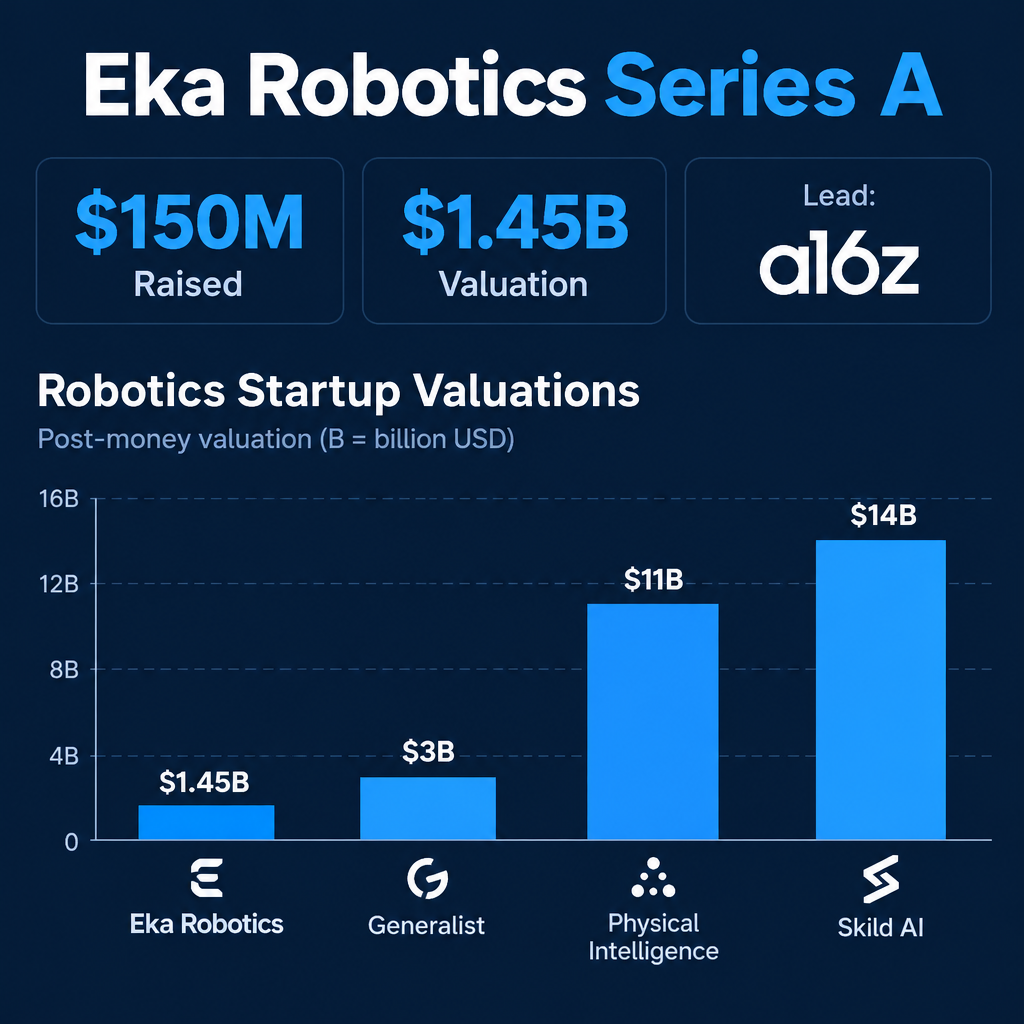
Eka Robotics has raised a $150 million Series A at a $1.45 billion post-money valuation, TechCrunch reported on 20 October 2026. The money is meant to scale the company’s “vision-force-action” model for dexterous robot grippers. Lead investor a16z announced its participation but gave no amount or valuation, so the numbers rest on TechCrunch’s reporting.
What we know
According to TechCrunch and SiliconANGLE, Eka was founded by MIT professor Pulkit Agrawal, who leads MIT’s Improbable AI Lab, and former Google DeepMind researcher Tuomas Haarnoja. The company started last year, which puts its founding in 2025. SiliconANGLE describes the valuation as “reported,” and the figure traces back to TechCrunch. I have only seen TechCrunch’s numbers as relayed by FourWeekMBA, Digg and SiliconANGLE, not on the original page.
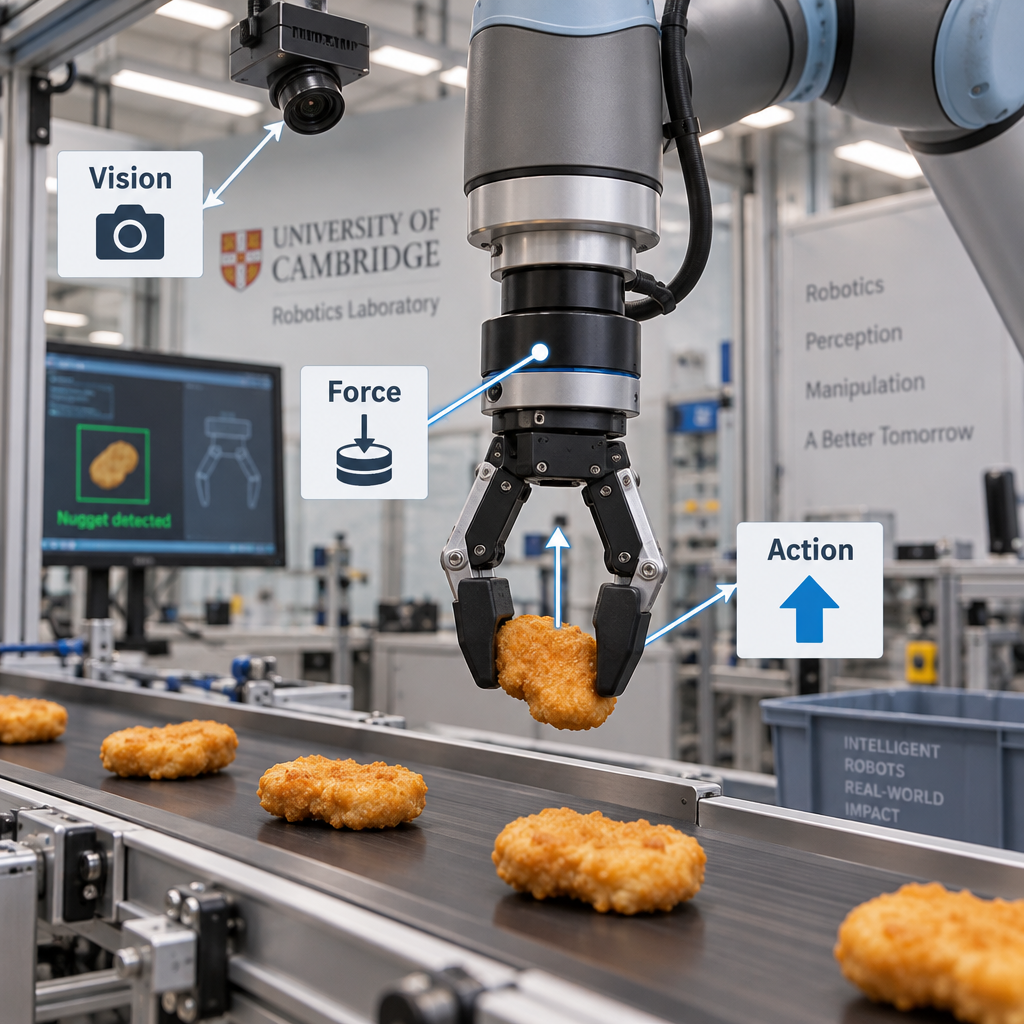
The product is a control architecture built around force-sensitive grippers and a model that takes in vision and force signals and outputs actions. Eka says the gripper costs under $1,000 and is rated for 5 million cycles, per TechCrunch’s reporting. Eka also says it is piloting pick-and-place and cable handling with multiple industrial customers. Those are company figures, not independent measurements.
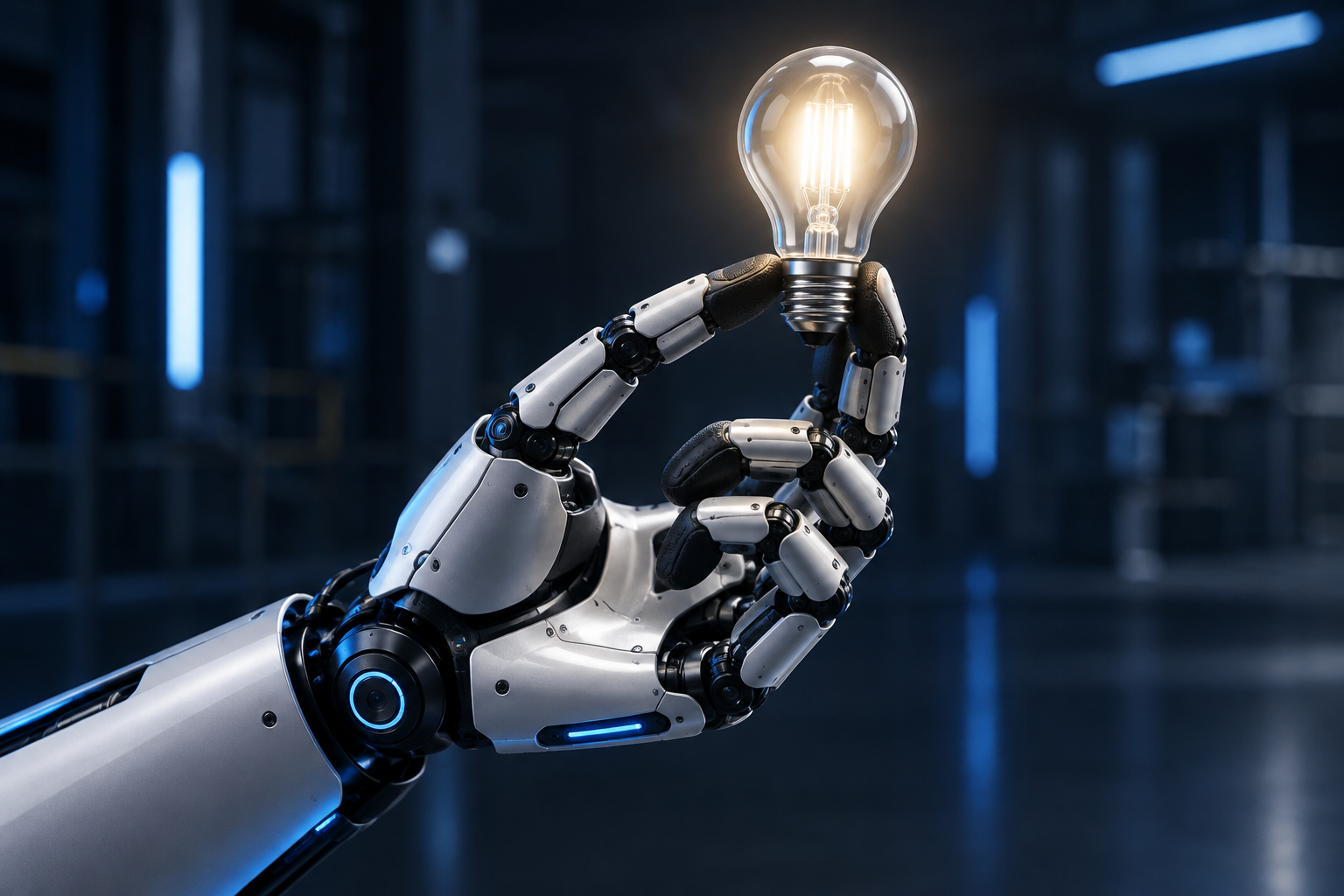
Wired’s Will Knight got an early look in a piece published April 29, 2026. At Eka’s Cambridge, Mass. office, an earlier version of the grippers screwed in light bulbs and packed chicken nuggets onto a moving conveyor. Wired described the model as trained in a simulation that builds in realistic joints, motors and physics. Eka says its policies are trained in simulation with reinforcement learning.
What we don’t know yet
The biggest gap is the demos themselves. None of the coverage I found says whether the Wired or TechCrunch demonstrations ran autonomously, followed a script, were sped up, or involved teleoperation. Until Eka or a reporter states that plainly, treat the autonomy of those demos as unverified.
The performance numbers have the same problem. Figures of 1,500 picks per hour and 95%+ reliability, along with the 5-million-cycle gripper rating, come from Eka and its investors. One outlet covering the round reported that industrial adoption is still pending as Eka targets 20 million duty cycles. We have no named customer, no deployment duration, and no third-party failure data.
We also don’t know how far the approach travels. Kris Hauser, a professor at the University of Illinois Urbana-Champaign, told TechCrunch it is unclear how well it generalizes beyond pick-and-place.
What it means
The pitch makes engineering sense. A vision-only system has to infer contact from pixels: whether a bulb is seated, whether a cable is caught, whether a nugget is about to slip. A force signal measures that contact directly, so a policy trained on both can in principle react to things a camera sees late or not at all. Light bulbs and moving conveyors are good stress tests for exactly that reason.
Whether Eka has proven this in production is a separate question, and the expert quoted in the funding coverage doesn’t claim it has. Hauser told TechCrunch the demo had a “wow factor.” In the same breath he questioned whether the robot could run on an assembly line for a year without failure, and he named a year of reliable operation with integrators on real lines as the hard test. That praise is about a demo. It is not about deployed results.
The valuation context explains why investors aren’t waiting. TFN reported on 21 October 2026 that Physical Intelligence is reportedly valued at about $11 billion. Generalist raised nearly $200 million in August at a reported $3 billion, and Skild AI raised $1.4 billion in January at over $14 billion. Next to those, $1.45 billion for a narrower, hardware-plus-model play is modest.
The checkpoints to watch are named customers, autonomy disclosures for the demos, and failure data from a line that has run for months. Until then, Eka has a plausible architecture, a cheap gripper on paper, and one well-funded bet on the idea that robots need to feel what they grab.
Keep reading
 Robotics NewsMusk calls Optimus and Cybercab most of Tesla’s value; no scale proof yetMusk says Optimus and Cybercab will be most of Tesla's value, but no independent deployment is verified. Here…Oct 21, 2026 · 4 min read
 Robotics NewsUnitree warns of valuation regression as its trailing P/E reaches 388xUnitree's Oct 20 filing shows a 388.25x trailing P/E versus a 39.51x industry average and warns of valuation…Oct 21, 2026 · 3 min read
 Robotics CompaniesTop robotics companies leading the industry todayMost lists of robotics companies mix shipping industrial giants with startups that have only posted a video. We…Oct 21, 2026 · 20 min read