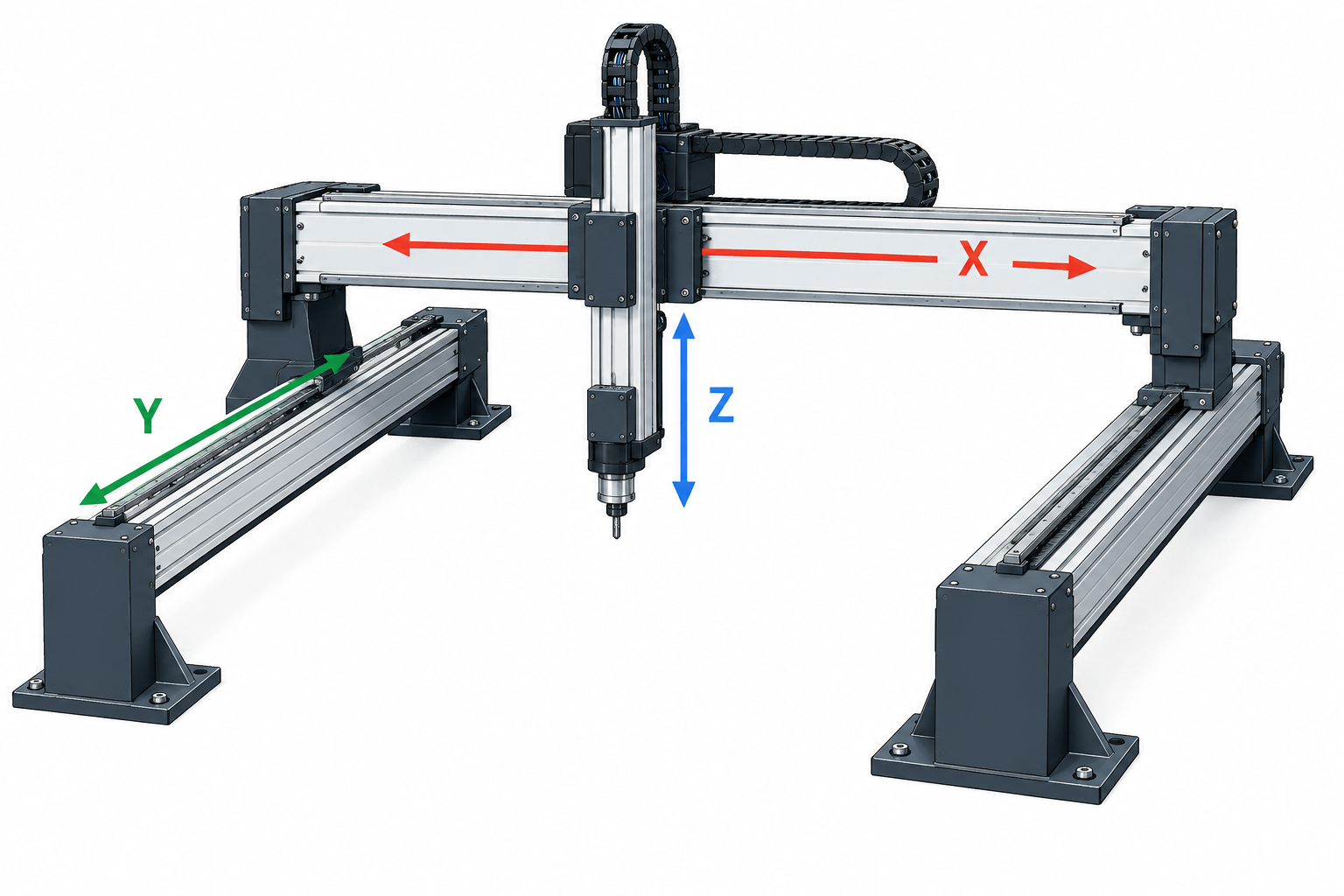
Cartesian systems are robots that move a tool along three straight, perpendicular axes (X, Y and Z), so every position the controller commands maps directly to a coordinate in a rectangular workspace. A gantry arm is the bridge-style version of the same idea: the moving beam is supported at both ends rather than hanging off one side. Below we cover how these machines work, where they beat articulated arms, and where they fall short.
A note on the search term
Searches for “cartesian systems” also return unrelated results. One is a staffing and workforce company called Cartesian Systems, Inc. Another is a Boston-area startup named Cartesian, which MIT News covered for helping retailers track products in stores in real time. This article covers the robot, which takes its name from the Cartesian coordinate system.
What a Cartesian robot is
ISO 8373, the standard that defines robot vocabulary, describes a Cartesian (also called rectangular) robot as one whose arm has three prismatic joints with axes aligned to a Cartesian coordinate frame. Put simply, each motor moves the tool in a straight line along one axis. Nothing rotates unless a rotary axis is added at the end, which vendors usually label “theta” or “C”.
That arrangement is why the term “cartesian x y z” fits so well. Commanding the tool to (X, Y, Z) is a direct instruction, with no trigonometry in between.
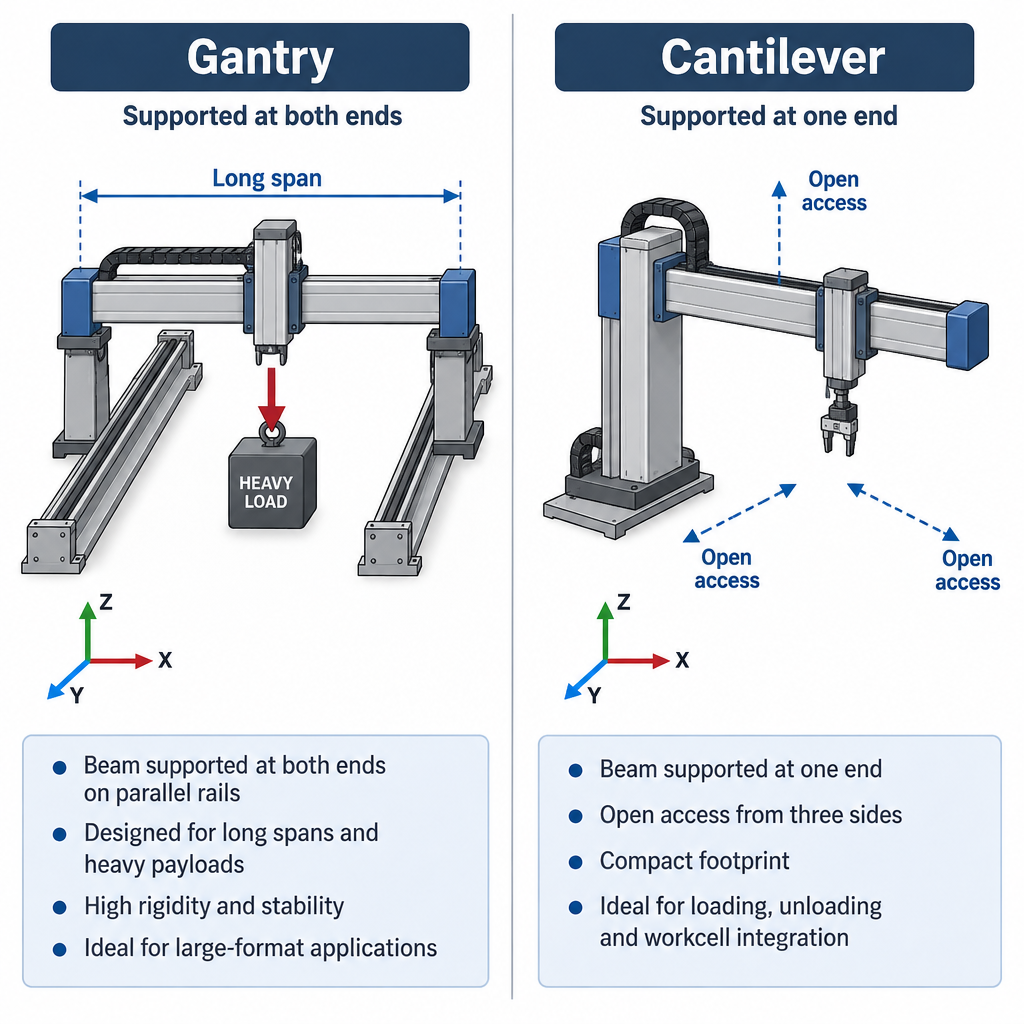
Gantry vs cantilever
| Configuration | How it is built | Typical strength | Typical drawback |
|---|---|---|---|
| Gantry | Beam supported on both ends by parallel rails | Long spans, heavy loads, high stiffness | Large footprint, needs overhead or frame space |
| Cantilever | Axis supported on one end only | Open access from three sides, compact | Deflection grows with reach and load |
| Single or two-axis | One or two linear modules | Cheap, simple transfer tasks | Limited to a line or plane |
How the motion works
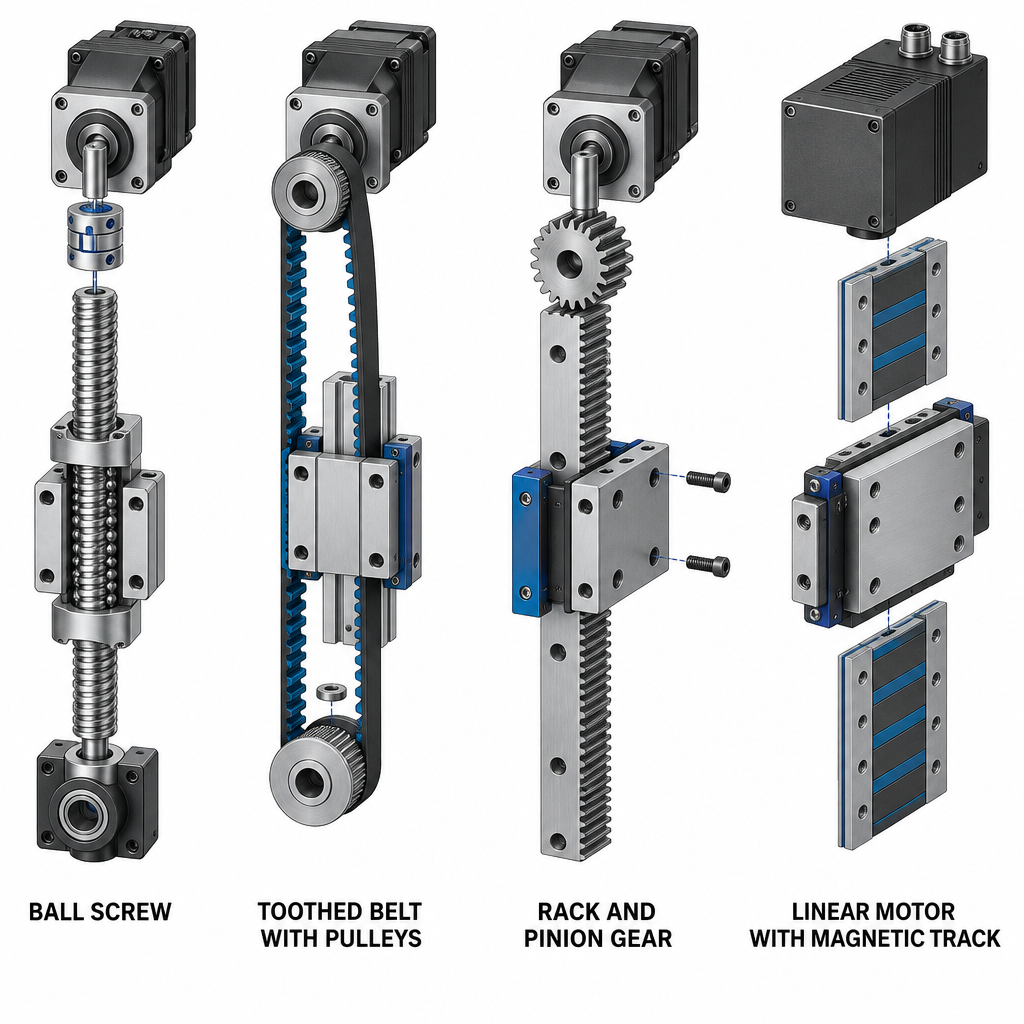
Each axis is a linear module made of a rail, a carriage and a drive. The common drives are:
- Ball screws for precision and good stiffness over moderate strokes.
- Toothed belts for long strokes and fast moves where some compliance is tolerable.
- Rack and pinion for very long gantries, including floor-to-ceiling installations.
- Linear motors for high speed and accuracy with no mechanical transmission.
Because each axis carries the same kind of load across its stroke, positioning behaviour stays fairly consistent throughout the workspace. An articulated arm, by contrast, changes its stiffness and resolution as its joints fold and extend.
Engineer's note
When a spec sheet quotes repeatability for a Cartesian system, check which drive and stroke it applies to. A belt axis and a ball-screw axis from the same vendor can differ a lot, so the headline figure rarely describes the whole machine.
Where they are used
We see Cartesian kinematics everywhere once we start looking. Desktop 3D printers, CNC routers, laser cutters and electronics pick-and-place machines are all Cartesian systems. In factories, gantry robots load machine tools, palletise cases, and handle sheet metal and automotive parts across spans no floor-mounted arm could reach. Suppliers including Güdel, Festo, Bosch Rexroth and IAI build modular axes or complete gantry systems, and our roundup of leading “robotics companies” covers the wider field.
Software and modelling
Most industrial units run on a PLC or a dedicated motion controller, and machine-tool variants accept G-code. In ROS, each axis is modelled as a prismatic joint in URDF, so tools like MoveIt can plan for a gantry the same way they plan for an arm.
<joint name="x_axis" type="prismatic">
  <parent link="base_link"/>
  <child link="x_carriage"/>
  <axis xyz="1 0 0"/>
  <limit lower="0.0" upper="1.2" effort="500" velocity="1.0"/>
</joint>
The limits above are placeholder values for illustration, not a real product spec.
Limits worth knowing
A Cartesian robot cannot reach around obstacles or into a box from the side, and it cannot reorient a part without extra rotary axes. Its frame is always larger than its working volume, which costs floor or ceiling space. Pricing depends heavily on stroke, payload and drive type, and we have not found a reliable industry-wide price range to quote.
Reality check
“Cartesian” describes kinematics, not quality. Accuracy, speed and payload come down to the specific axes, drives and frame, so compare datasheets rather than categories.
FAQ
Is a gantry robot the same as a Cartesian robot?
A gantry robot is one type of Cartesian robot. All gantries use linear XYZ axes, but not every Cartesian robot is a gantry, since cantilever designs are also common.
Why choose a Cartesian robot over a six-axis arm?
We choose them for large rectangular work areas, heavy or long parts, simple programming and consistent accuracy. Six-axis arms win when the tool needs to approach from many angles.
Is a 3D printer a Cartesian robot?
Most are. A typical printer moves the nozzle or bed along X, Y and Z with belts or lead screws, which fits the definition exactly.
Keep reading
 Robotics CompaniesTop robotics companies leading the industry todayMost lists of robotics companies mix shipping industrial giants with startups that have only posted a video. We…Oct 21, 2026 · 20 min read
 Robotics NewsMusk calls Optimus and Cybercab most of Tesla’s value; no scale proof yetMusk says Optimus and Cybercab will be most of Tesla's value, but no independent deployment is verified. Here…Oct 21, 2026 · 4 min read
 Robotics NewsUnitree warns of valuation regression as its trailing P/E reaches 388xUnitree's Oct 20 filing shows a 388.25x trailing P/E versus a 39.51x industry average and warns of valuation…Oct 21, 2026 · 3 min read