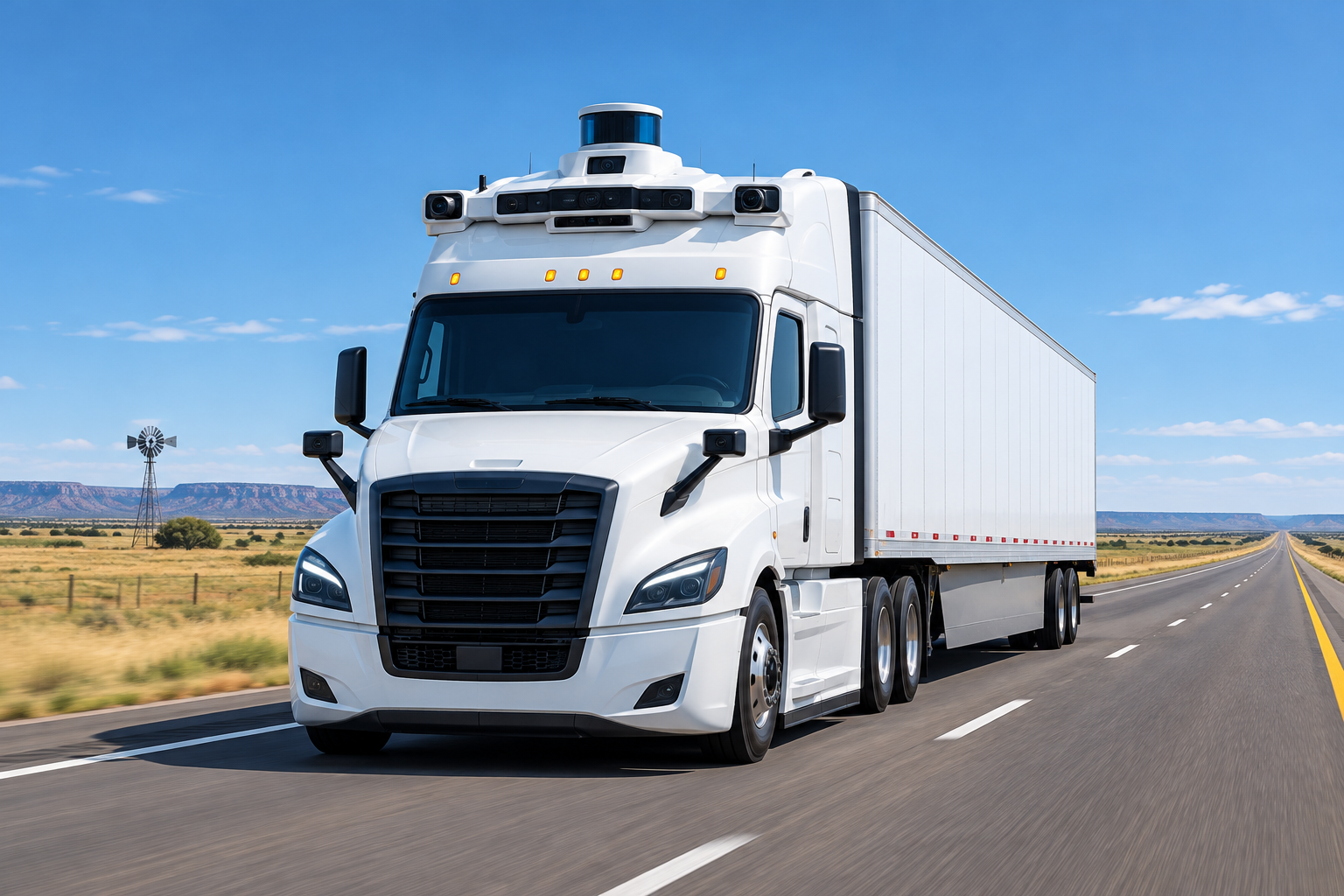
Aurora Innovation is a Pittsburgh-based self-driving technology company that builds the Aurora Driver, a hardware and software system that lets heavy trucks haul freight without a human at the wheel. In 2025 it became the first company to run commercial driverless Class 8 trucks on a US public highway, starting on Interstate 45 between Dallas and Houston. Below, we cover what Aurora makes, how its trucks see the road, what is running today versus what is still a plan, and how it compares with rivals.
Company overview
Aurora was founded in 2017 by three engineers with deep self-driving histories. Chris Urmson led Google’s self-driving car project. Sterling Anderson ran Tesla’s Autopilot program. Drew Bagnell came from Carnegie Mellon and Uber’s autonomy group. Urmson is the CEO.
The company started out working on both passenger cars and trucks. It ran a robotaxi program with Toyota on the Sienna minivan, then narrowed its focus to long-haul trucking. The reasoning made sense. Highway driving between two depots is more structured than city streets, and freight carriers have a clear cost problem: driver shortages, hours-of-service limits, and trucks that sit parked half the day.
Two deals shaped the company. In 2019 Aurora bought Blackmore, a lidar startup working on frequency-modulated continuous wave (FMCW) sensing. In January 2021 it closed its acquisition of Uber’s self-driving unit, Uber ATG, with Uber investing $400 million as part of the deal. Aurora then went public in November 2021 through a merger with Reinvent Technology Partners Y, a SPAC, and trades on Nasdaq as AUR.
How Aurora self-driving trucks work
The Aurora Driver is the product. It is a bolt-on stack of sensors, compute, and software that truck makers integrate into their vehicles at the factory. Aurora does not build trucks itself.
Seeing the road
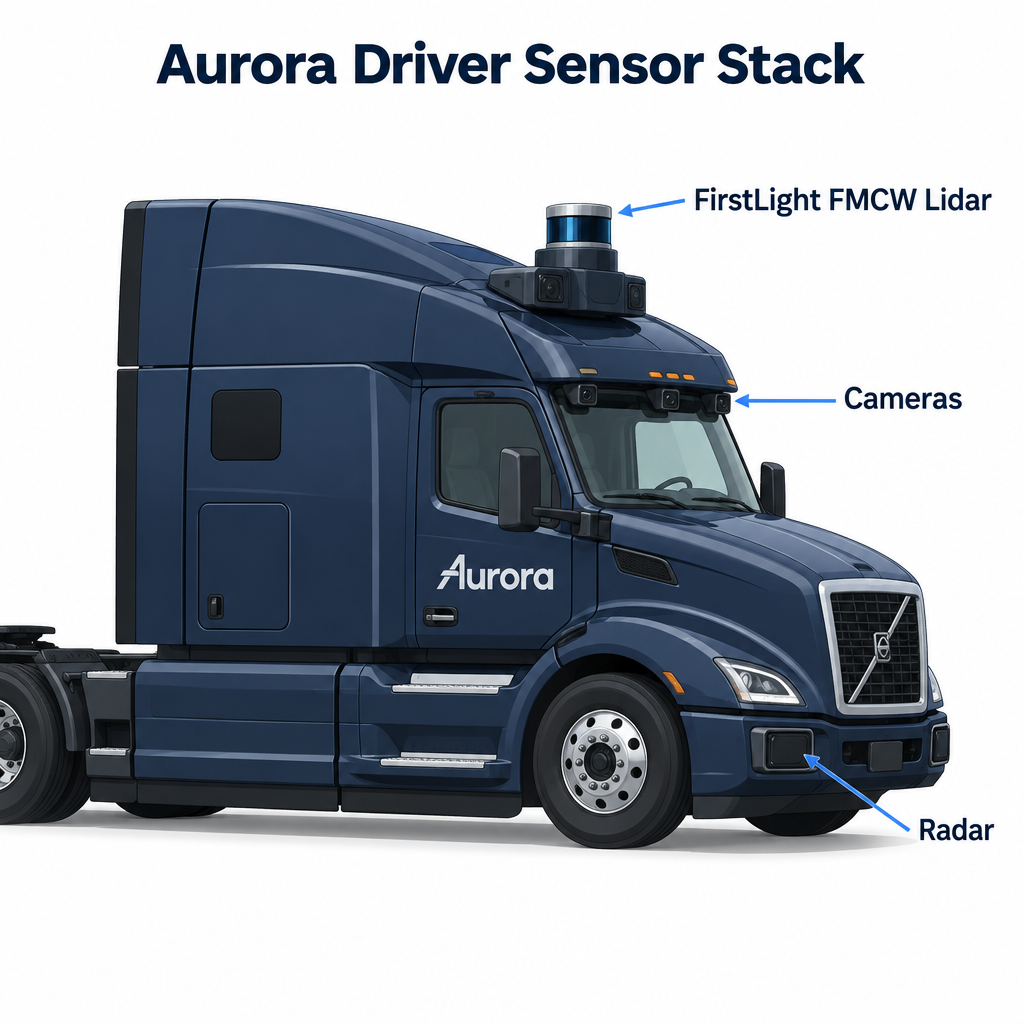
The core sensor is FirstLight, Aurora’s in-house FMCW lidar descended from the Blackmore acquisition. Conventional time-of-flight lidar measures distance. FMCW lidar measures distance and also the speed of each point, directly, in a single frame. For a truck moving at highway speed, knowing instantly that a far-off object is a stopped car versus a moving one buys valuable braking time. A loaded semi needs far more distance to stop than a passenger car.
Cameras and radar sit alongside the lidar, and the system fuses all three. The software then predicts what other road users will do and plans the truck’s path.
Engineer's note
When Aurora quotes detection range, check whether the figure refers to detecting an object or classifying it. Spotting “something” at long range and knowing it is a pedestrian on the shoulder are different problems, and press releases rarely separate them.
Proving it is safe
Aurora leans on what it calls a safety case: a structured, published argument for why its trucks are acceptably safe to run without a driver, backed by simulation, test-track work, and on-road miles. We think this is a better approach than simply citing total miles driven, because it forces the company to state its assumptions where outsiders can attack them.
What is running today versus what is planned
This is where Aurora autonomous trucks deserve precise language.
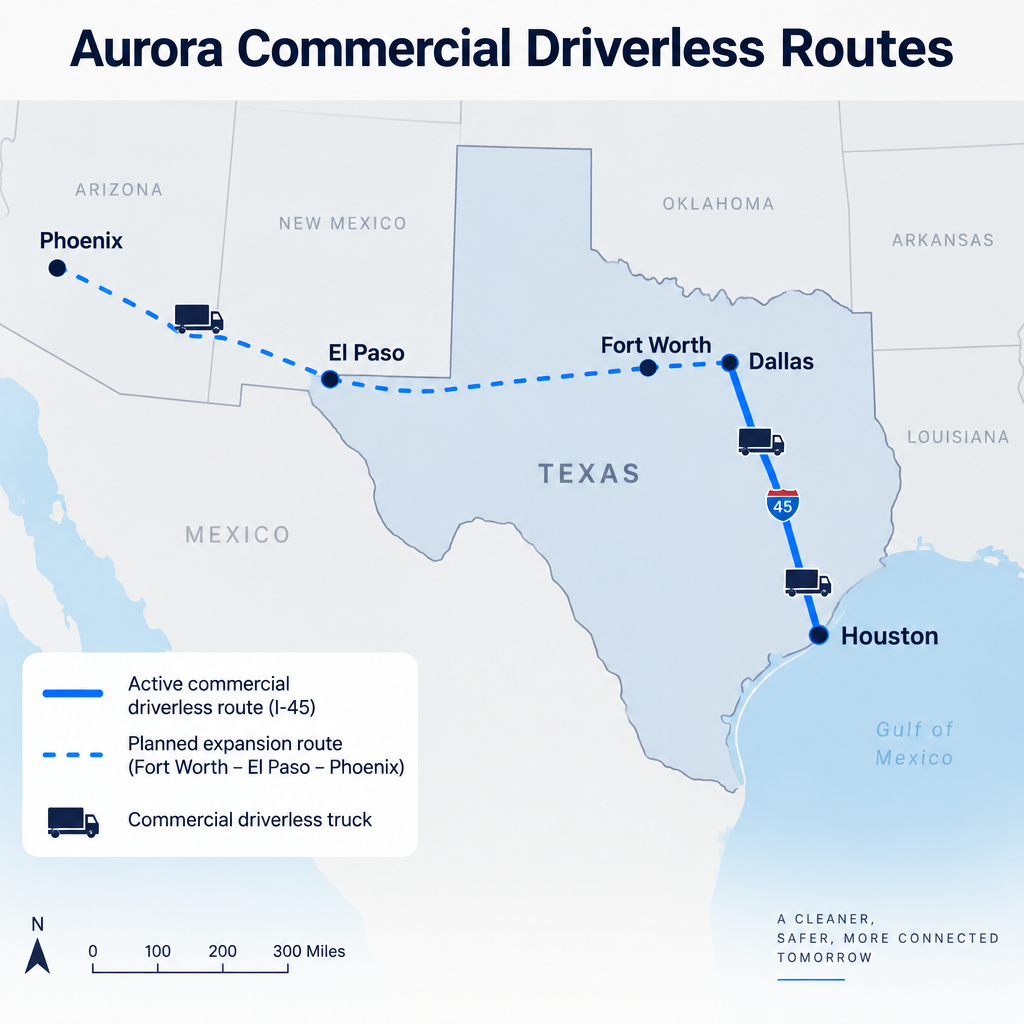
Shipped: In late April 2025 Aurora began commercial driverless runs on I-45 between Dallas and Houston, carrying paying loads for early customers including Uber Freight and Hirschbach. The trucks operate between Aurora-run terminals on a defined route.
Changed after launch: Within weeks, Aurora put a person back in the driver’s seat as an observer. The company said this came at the request of truck maker PACCAR, one of its manufacturing partners. The software still does the driving, but “no one in the cab” stopped being accurate for those trucks.
Planned: Aurora has laid out expansion along a Fort Worth to El Paso corridor and on toward Phoenix, plus night and adverse-weather operations. It is also developing a cheaper next-generation hardware kit with Continental and NVIDIA, built around the DRIVE Thor computer, aimed at volume production around 2027.
Reality check
Aurora’s driverless operations cover a small number of trucks on a few Texas corridors. Running thousands of trucks across many states, in snow and heavy rain, has not been demonstrated yet.
Funding history
| Round | Date | Amount (approx.) | Notes |
|---|---|---|---|
| Series A | 2018 | $90M | Greylock and Index Ventures |
| Series B | 2019 | $530M+ | Led by Sequoia; Amazon participated |
| Uber ATG deal | Jan 2021 | $400M | Uber investment alongside the acquisition |
| SPAC merger | Nov 2021 | ~$1.8B gross | Reinvent Technology Partners Y |
| Capital raise | Jul 2023 | ~$820M | Public offering plus private placement |
| Capital raise | Aug 2024 | ~$483M | Public stock offering |
Aurora is not yet profitable and has funded its operations by repeatedly raising capital. Anyone reading its latest results should look first at cash burn and runway. Its investor relations site carries quarterly results, the latest annual filing (10-K), presentation decks, and upcoming earnings call dates. Aurora’s newsroom posts press releases on partnerships and route launches.
Partners and customers
Aurora’s go-to-market depends on truck makers and carriers:
- Truck makers: PACCAR (Peterbilt and Kenworth), Volvo Autonomous Solutions, and International Motors.
- Hardware: Continental for production-grade hardware; NVIDIA for compute.
- Freight customers and pilots: Uber Freight, Hirschbach, Werner, Schneider, and FedEx have all worked with Aurora at various stages.
The model is “Driver as a Service.” Carriers pay per mile for the Aurora Driver rather than buying the software outright.
How Aurora compares
| Company | Focus | Status (2025) |
|---|---|---|
| Aurora Innovation | Long-haul Class 8 highway | Commercial driverless runs in Texas |
| Kodiak Robotics | Long-haul and off-road industrial | Driverless trucks in the Permian Basin; public via SPAC |
| Waabi | Long-haul, simulation-heavy | Building toward driverless with Volvo |
| Plus | Factory-installed autonomy | Working with truck makers; going public via SPAC |
| Gatik | Middle-mile box trucks | Short fixed routes for retailers |
Waymo shelved its trucking arm, Waymo Via, in 2023 to focus on robotaxis. TuSimple left the US market. That shakeout left Aurora in the lead on public-highway driverless freight. For a broader look at the field, see our roundup of top “robotics companies“.
Careers at Aurora
Aurora hires across software, perception, hardware, safety, and truck operations, mainly in Pittsburgh, the San Francisco Bay Area, Seattle, and Texas. Its careers page advertises health benefits, paid leave, flexible vacation, and hybrid schedules for many roles. Exact benefits vary by location and job type, so check the specific posting.
Our take
Aurora has done the hardest thing in autonomous trucking so far: running paying freight on a public interstate under its own software. The observer-in-the-cab reversal shows that partners still set the pace, and scale depends on cheaper hardware arriving on schedule. As with the “tesla optimus outlook“, the right question is when the business works at volume, not whether the demo works.
FAQ
What does the Aurora company do?
Aurora Innovation develops the Aurora Driver, a self-driving system for heavy trucks. It sells the system to freight carriers on a per-mile basis, with truck makers such as PACCAR and Volvo building it into their vehicles.
Are Aurora trucks really driverless?
The software drives the truck. Aurora launched commercial driverless runs in late April 2025, with an observer riding in the back seat on some trips, then moved that observer to the driver’s seat at PACCAR’s request. That person does not drive.
Where does Aurora driving happen today?
Commercial operations started on I-45 between Dallas and Houston. Aurora has announced expansion toward El Paso and Phoenix.
Who founded Aurora Innovation?
Chris Urmson, Sterling Anderson, and Drew Bagnell founded Aurora in 2017.
Is Aurora a public company?
Yes. Aurora trades on Nasdaq under the ticker AUR after its November 2021 SPAC merger.
Keep reading
 ROS & Robot SoftwareWhat ROS 2 is and why more robots are moving to itROS 2 is a free, open-source framework for building robot software. It provides the messaging layer, tools and…Oct 21, 2026 · 20 min read
 Industrial & Service RobotsCartesian robots and XYZ gantry systems explainedCartesian systems are robots that move a tool along three straight, perpendicular axes (X, Y and Z), so…Oct 21, 2026 · 4 min read
 Robotics CompaniesTop robotics companies leading the industry todayMost lists of robotics companies mix shipping industrial giants with startups that have only posted a video. We…Oct 21, 2026 · 20 min read